Chichikov arrives in a provincial town, is charming to everyone, and begins quietly buying dead people.
Not bodies. Names. Under serfdom a landowner’s wealth was counted in souls, meaning male serfs, and the count was fixed by a census that might be years out of date. Serfs who had died since were still on the books, still taxed, still property. Chichikov’s plan is to buy them cheaply from landowners glad to stop paying tax on the dead, then mortgage his imaginary workforce against a very real loan.
It is a fraud built entirely out of paperwork, which is why it has aged so well.
The word doing the work
Russian uses one word, dusha, for the soul you are told you have and the serf you were told you owned. The censuses counted revision souls. A man with four hundred souls had four hundred male serfs on his register, and paid the poll tax on all four hundred until the next revision came round, which might be a decade later. In the meantime the dead stayed on the list, and he went on paying for them.
So a landowner sitting on a dozen names of men buried two winters ago is quietly losing money every year. Chichikov offers to take the problem off his hands. Some are baffled. One is convinced she is being cheated and wants to know the going rate. One tries to throw in a puppy. All of them, in their different ways, are pleased to see him.
The five houses
The caper is only the frame. The reason the book survives is the five estates Chichikov visits, because Gogol uses them to assemble a small museum of ways to be alive and not much else.
Manilov is so agreeable, so relentlessly pleasant, that he has never in his life finished anything. Korobochka, a widow, cannot follow the transaction at all and worries chiefly about being underpaid for goods she cannot describe. Nozdryov lies for the pleasure of it and would rather start a fight than close a sale. Sobakevich, built like a bear and about as sentimental, treats his dead serfs as stock and haggles hard over every one. Plyushkin, once a competent and even generous man, has hoarded his estate into rot; his peasants go hungry while his storerooms fill with things long past use.
Readers remember Plyushkin. Gogol plainly did too, and that chapter turns, briefly, from comedy into something nearer grief.
The dead souls of the title are the names on the list. They are also the men selling them.
Pushkin handed him the plot
Gogol did not invent the scheme. Pushkin gave it to him, as he had already given him the premise of The Government Inspector, and is said to have regretted it slightly afterwards on the grounds that Gogol had taken a perfectly good idea and made it entirely his own.
The censors had a point
The Moscow censorship committee objected to the title, and not on political grounds. Souls are immortal; a dead one is a contradiction and possibly a blasphemy. The book appeared in 1842 as The Adventures of Chichikov, or Dead Souls, a compromise that tells you more about the period than a page of background would.
It is not a novel, apparently
Gogol printed the word poem on the title page. He meant it structurally rather than as a boast. The plan was three parts on the Dantean model: this one the inferno, a second climbing out of it, a third arriving somewhere better.
What happened to the rest
He never got there.
He wrote the second part, was dissatisfied with it, and burned it around 1845. He wrote it again over the following years. Then, in late February 1852, under the influence of a priest who had persuaded him that his fiction was sinful, he burned it a second time and stopped eating. He died nine days later, aged forty-two.
What survives of Part Two is a handful of drafts, pulled from the fire or reconstructed from copies. Part One is whole, and ends on the image people were still quoting a century later. Part Two simply stops, in the middle of a sentence.
A book about spiritual paralysis, abandoned twice and left unfinished by a man who starved himself at forty-two.
Nikolai Gogol · 1809–1852Why we took the name
Because the joke is the same one. This app files the bleakest lines in Russian literature under the cheerful headers of wellness culture, which works by putting something inert next to something insisting on being lively and letting the gap do the talking. Gogol got there first, with better material.
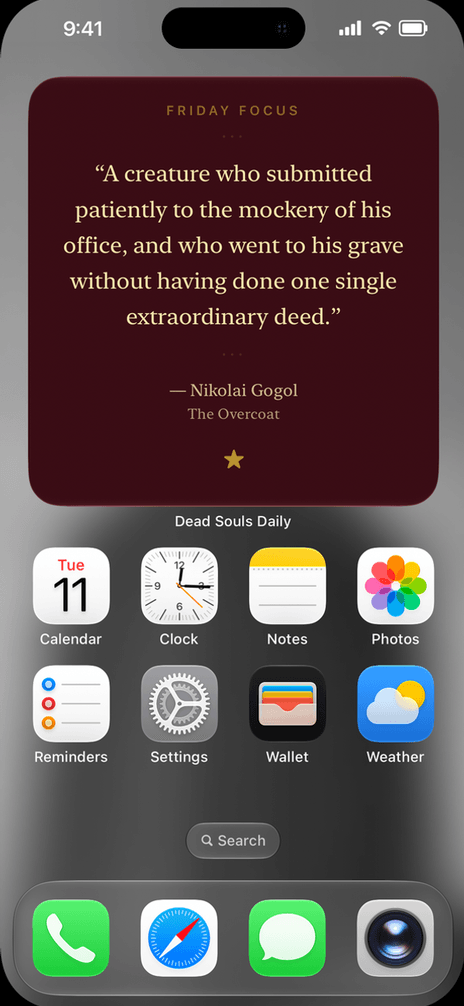
It helps that he is in the collection. The Overcoat supplies one of the lines the app hands out most often, on the subject of a man who endured the mockery of his office and went to his grave without having done anything remarkable. It tends to arrive on a Friday.
Where to read it
Part One runs to about three hundred pages and moves quickly. The original Russian is out of copyright everywhere, and so are the older English translations. Newer ones are not, so if you are downloading rather than buying, check what you are actually getting.
Project Gutenberg has the public-domain translations. Standard Ebooks sets the same sources in rather better typography, if you would rather read something that looks designed.
Either way, the first chapter will tell you inside ten pages whether you want the other ten.
Gogol is not where most people start with the Russians. If you would rather begin with Dostoevsky, there is a guide to that.
One masterpiece of Russian literature, every morning.
Free on iPhone and Android. The antidote to toxic positivity, delivered daily.